Roy Rafferty
Mrs. FletcherRoy Rafferty’s story turns on the distance between the sociable, considerate regular people remembered at the Senior Center and the confused, rapidly declining man whom the Center can no longer accommodate. After his wife dies, dementia changes his behavior within months; when he is barred from returning, he dies only about a month later, leaving Eve Fletcher to reckon with the human cost of a decision she had considered unavoidable.
Life Before His Decline
Roy is eighty-two and had been a longtime Senior Center regular. Before his dementia took hold, he was healthy, lucid, and conspicuously friendly: a talkative man who greeted people, shook hands, and asked after their grandchildren. Eve Fletcher counted him among her favorites, and later recalled that he had been kind and considerate to many people. His good standing was not limited to the Center. He had deep ties to Haddington, belonged to several civic organizations, and had built a long, successful career as a plumbing contractor.
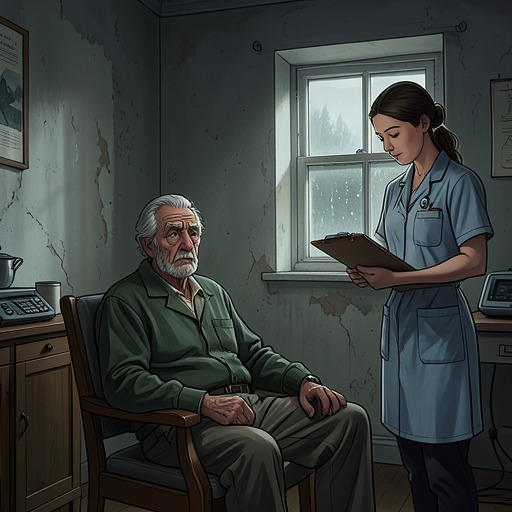
That public warmth makes the change in Roy especially stark. His wife died of a massive stroke, and his decline afterward was both rapid and alarming. About six months after her death, he could no longer reliably follow the conversation around him. When Eve tried to explain why he had been summoned, he asked whether it was time for lunch, despite having already eaten, and then wondered whether he had done something wrong. His loud lip-smacking and strained, scowling concentration give the scene small, concrete signs of a cognitive change that neither he nor his son can simply will away.
Incidents and Exclusion
Roy’s difficulties at the Center had become recurrent. On one earlier occasion, while riding the Elderbus home from the supermarket, he stood on his seat and urinated out the window; witnesses said he had only partly succeeded. Later, he went into the women’s room again, and the incident Eve had to address involved indecent exposure there. Roy did not seem to understand the reason for the meeting or remember what he had done. His behavior affected other people at the Center, including Evelyn Gerardi, an emphysemic woman who had been the victim of his indecent overtures.
Eve summons Roy and his son, George Rafferty, to the Center. She meets George while he is still in work clothes from a plumbing job, grease on his face and years of grime darkening his knees. George’s wary question about what his father has done this time reflects a history of troubling episodes. Eve tells Roy that staff members have valued his company and that he has been kind to them, but that he can no longer attend. The Center is a community facility, she explains, and he needs a nursing home. Her decision is presented not as a punishment for a single lapse but as a limit imposed by a setting unable to provide the care his condition now requires.
Death and Aftermath
Roy dies about a month after Eve excludes him from the Center. At the wake, the speed of that reversal unsettles her: she had not known he had so little time left, and the memory of sending him away now feels cruel and pointless. She does not conclude that she had a choice as an administrator, but the decision still weighs on her. Having inflicted pain on someone she cared about, even while doing her job, leaves her feeling mean and uncertain about whether she is right to continue in her role.
The crowded parking lot and full viewing room offer a counterimage to the Center’s final meeting with Roy. Mourners line the room to approach his open coffin, honoring the relationships built over a lifetime in Haddington, his civic involvement, and his years as a plumbing contractor, as well as the kind man he had been before dementia. Eve sits near the Center’s regulars rather than joining the procession. The strong turnout confirms that Roy’s life exceeded the disruptive behavior of his final months, while Eve’s grief preserves the unresolved cost of separating care from belonging.
Character and Significance
Roy is shown through a before-and-after contrast rather than through an extended account of his own perspective. His earlier friendliness survives in the memories of the people around him, while his confusion is conveyed through repeated incidents and his inability to understand why he is in trouble. That contrast resists reducing him to either a beloved community fixture or a management problem: he is both the person others remember and the person whose changing needs exceed what the Senior Center can manage.
His expulsion also reveals the limits of a community institution built around companionship and activities. The Center can welcome Roy as a regular while he is lucid and safe to participate, but it cannot replace the higher level of care he needs as his condition worsens. His death soon afterward does not make Eve’s decision straightforwardly right or wrong; instead, it makes visible the sorrow that can accompany an administratively necessary exclusion, especially when the person excluded cannot fully understand it.